School of Integrative Engineering, Chung-Ang University
Educating Global Leaders in the Emerging Field
Department of Nanomaterials Engineering
1. Department Introduction
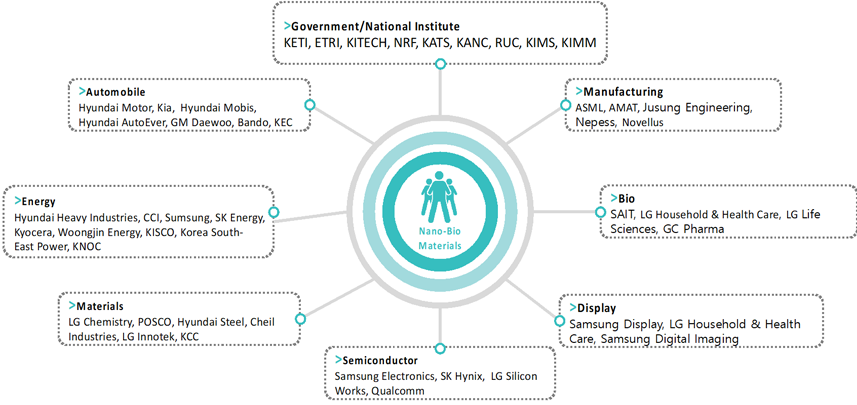
Department of nanomaterials engineering aims to address materials challenges hampering the development of information and energy technologies which are the essential components in the 4th industrial revolution, by utilizing nanotechnology. Toward this goal, our department approaches problems from the interdisciplinary perspective integrating various engineering disciplines such as materials, chemicals, electrical, and mechanical engineering, whose synergetic effect will derive more creative and impactful solutions. Specifically, we research the development of new synthesis and manufacturing methods of novel nanoparticles and their various applications for energy storage/conversion, semiconductor, sensor, and nanosystems. To this end, we cultivate leading expertise in the field of nano-bio materials by providing systematic curriculums ranging from basic scientific knowledge strengthening the problem-solving ability to hands-on experimental activities applicable to the current industry front.
2. The goal of education
- Foster abilities designing innovative nanomaterials systems.
- Train global talents with teamwork and leadership.
- Nurture engineer serving society with social responsibility and lifelong self-development
3. Research Goal
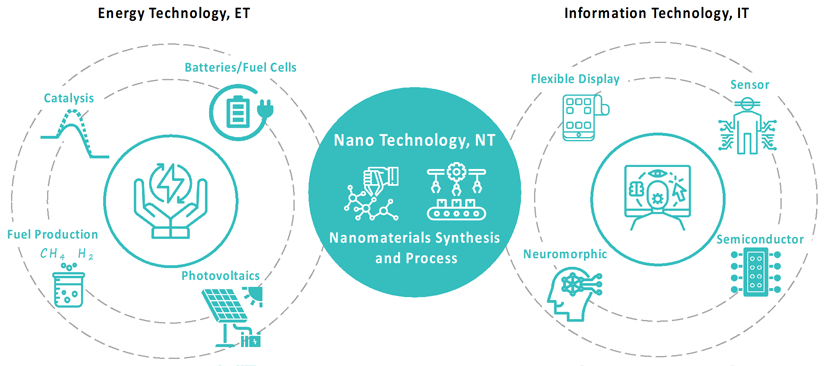
Nanotechnologies design, synthesize, and utilize materials from the nanoscale, the unit of an atom, to develop novel materials with enhanced performance unattainable with traditional approaches. Innovation in information technology (IT) and energy technology (ET) sectors using nanomaterials will bring a new paradigm in the 4th Industrial Revolution. Our department provides an inclusive environment where fosters the interdisciplinary perspective integrating material engineering, chemical engineering, electrical engineering, and mechanical engineering to derive more creative and innovative solutions.
- Nanotechnology
- For the applications of nanomaterials to various fields, the development of new nanoparticles and their manufacturing processes must precede. To this end, we are innovating the synthesis and manufacturing process for novel nano-sized ceramics, polymers, and metal particles. We also research the diagnosis method of nanomaterials processes and the discovery of new materials by computer simulations.
- Information Technology
- As we advance towards the AI era, innovating semiconductors to process the ever-increasing amount of data and devising a new display/sensor system to connect the cyberworld and humans will play a pivotal role in this transition. We are pioneering the fields of neuromorphic semiconductors and flexible display/sensor systems using nanotechnologies such as quantum dots, nanopatterning, and nanocrystal.
- Energy Technology
- In the upcoming renewable energy era, novel energy storage (e.g. batteries, fuel cell) and conversion (e.g. solar cell, catalyst) materials will be of enormous importance. We aim to increase energy storage capacity and conversion efficiency by applying nanotechnology to electrochemical and photovoltaic materials, resulting in innovation in energy storage/conversion fields.