School of Integrative Engineering, Chung-Ang University
Educating Global Leaders in the Emerging Field
Department of Biomedical Engineering
1. Department Introduction
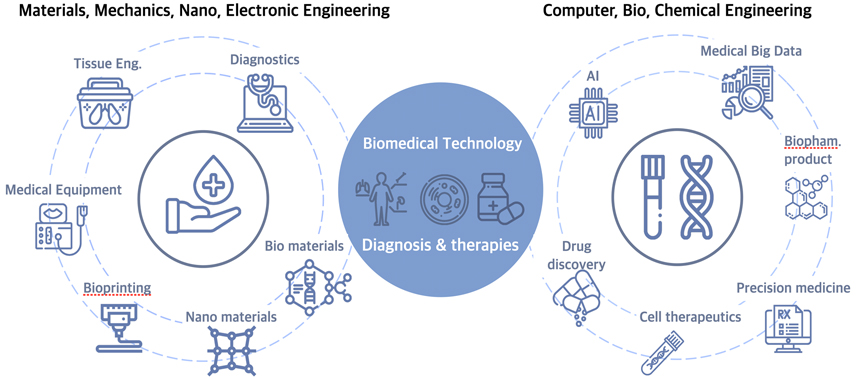
The goal of the Biomedical Engineering department is to foster students to resolve a series of problems in medical and biological areas. The field of biomedical engineering studies is an interdisciplinary area that integrates the essential pieces of knowledge of scientific, engineering, medical and biological fields. Students will build their multidisciplinary competency foundation built on materials, chemical engineering, mechanical engineering, informatics, computer science, etc., merged with biological and medical knowledge. Our department's curriculum is formulated to be able to achieve such a goal by educating students to become multi-competent experts in the field.
2. The goal of education
- Foster whole expertise that can enter into biological and medical fields.
- Foster multidisciplinary expertise that can achieve consilience between multiple disciplines.
- Foster creative expertise that can contribute to the collective advancement of humanity by overcoming technological limitations.
Our ultimate goal is to contribute to the collective advancement of the human race by fostering whole multidisciplinary engineers. This will be achieved by the enhancement of knowledge in the biomedical engineering field.
Human-centered businesses are on the rise worldwide. Especially, maintaining a healthy lifestyle is becoming the focus of most business areas as we advance towards an aging society. As the lifecycle surrounding humanity and the ecogeological environment gains more interest, large industrialization is picking up speed on the foundation of groundbreaking technologies in chemical, biological, medical, and pharmaceutical areas. Therefore, keeping pace with such trends, our department targets cultivating expertise not only in engineering but also in biological and medical areas to reach out to the pharmaceutical and medical industries.
3. Career
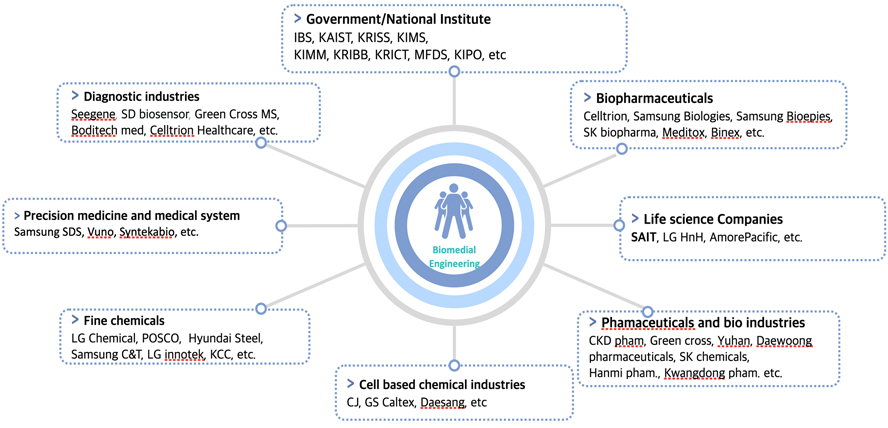
Our graduates are equipped with not only engineering but also bio-medical knowledge. Therefore, they can build their careers in pharmaceutical industries as well, not excluding traditional engineering industries. As a result, the spectrum of our graduates' career paths is more comprehensive than those of conventional engineering graduates. Our graduates' employed companies include Samsung Biologics, Samsung Bioepis, Celltrion, Yuhan Corporation, Green Cross, Kolma Korea, Meditocs, Daewoong Pharmaceutical, and LG Lifesciences. There are no significant differences in the employment rate between students who search for jobs after finishing graduate programs and students who search for jobs directly after earning a bachelor's degree. Our department's employment rate ranks high among all the majors. However, one should note that job descriptions may differ depending on the levels of degrees students graduate with.